
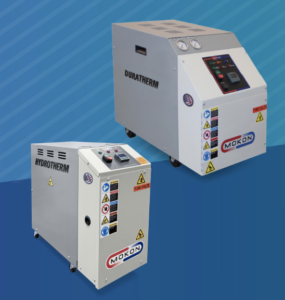
The materials used to construct a water-based temperature control system play a critical role in its performance, reliability, and longevity. At Mokon, we use stainless steel and non-ferrous metals—including copper, brass, and bronze—to help our systems withstand challenges such as scale and corrosion.
Our fully customizable Hydrotherm and Duratherm water temperature control systems combine these durable materials to provide dependable temperature control for demanding applications.
The Impact of Scale on Water Systems
Scale is one of the most common challenges in water-based systems. Hard water contains dissolved calcium and magnesium ions that can remain in solution under normal conditions. However, when water is heated or evaporates, dissolved bicarbonates can decompose, releasing carbon dioxide and causing calcium and magnesium to precipitate as solid mineral deposits.
Over time, these deposits can accumulate inside system components and piping, creating several operational issues:
- Reduced heating efficiency: Scale acts as an insulating layer, increasing energy consumption and potentially contributing to premature heater failure.
- Restricted flow and pressure: Deposits can reduce the internal diameter of piping, increasing strain on pumps and causing fluctuations in system pressure.
- Solenoid valve problems: Scale can interfere with valve operation, making it more difficult to maintain precise temperature control.
Why Material Selection Matters
Using the right combination of stainless steel and non-ferrous metals helps minimize these challenges while supporting efficient heat transfer and long-term system durability.
Copper, brass, and bronze offer several advantages in water-based applications. Copper provides excellent thermal conductivity, supporting efficient heat transfer during both heating and cooling. Because these materials contain little to no iron, they do not form the iron oxide rust associated with conventional iron-based components. Instead, they can develop protective oxide layers that help resist corrosion.
Stainless steel provides another layer of protection. Its chromium content—typically at least 10.5%—reacts with oxygen to form a thin, protective passive layer on the surface. This layer helps protect the underlying steel from corrosion, rust, and staining. Nickel and other alloying elements can further enhance corrosion resistance and durability, depending on the stainless steel grade.
Built for Reliable Temperature Control
Mokon’s Hydrotherm and Duratherm water systems combine high-quality materials with proven designs to deliver efficient, reliable temperature control. Both product lines feature non-ferrous wetted components, including stainless steel, copper, and brass, for durability and long-term performance.
Each system incorporates a stainless steel heating canister and diverter designed to create high-velocity, turbulent flow across the heating elements. This enhanced flow promotes more efficient heat transfer, improves overall system efficiency, and helps minimize scale buildup that can contribute to heater burnout. Stainless steel pump components further ensure consistent circulation while resisting rust and corrosion, supporting reliable operation in demanding industrial environments.
Our Hydrotherm and Duratherm systems are built to exact specifications, and base models are available in stock for shipment within 48 hours.
We also offer a variety of other water temperature control systems, depending on pump configuration, flow rate, and temperature requirements. All systems can be custom engineered to meet your specific application requirements.
Need a Hydrotherm or Duratherm for your next application? Contact Mokon’s team today to get started on creating your ideal water temperature control system.