
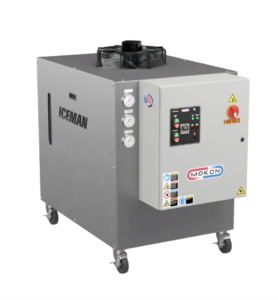
When it comes to the best location to place your chiller system, position is everything. A chiller that’s not properly placed in a room can lead to system complications, such as overheating and high-pressure. Our latest blog offers pointers on maximizing chiller position and getting the best out of your system.
How a Chiller Works
We’ll take a look at two types of chillers that operate based on heat rejection: air-cooled and water-cooled. The former is a refrigeration configuration that uses a vapor-compression cycle, with ambient air blown over the condenser coils. The condenser coil is important because it contains refrigerant that releases heat into the atmosphere. The heat can come from a process, a fluid (like glycol or water), or the interior space within a building. Air-cooled chillers are usually found in small- to medium-sized commercial or industrial environments.
Water-cooled chillers reject heat through a refrigeration cycle that uses a water-to-refrigerant heat exchanger. The cycle consists of liquid refrigerant absorbing heat from the process medium. Heat is then transferred from the refrigerant to water by means of a water-cooled condenser. Heat is typically rejected to the atmosphere via a cooling tower. This heat removal device transfers processed waste heat to the atmosphere through water.
The Inside Factors
If you’re planning on putting a chiller indoors, there are a couple of things to consider. For instance, the proximity of a chiller to its surroundings: chillers near the equipment they’re meant to cool allow for easy monitoring. A chiller should have enough open space around it to permit maintenance of condenser coils and component replacements. Refrain from placing the chiller in a confined space or next to other chillers, as this will recycle hot air and lead to increased system strain and reduced efficiency. Without enough airflow and ventilation, the chiller’s compressor will have to work harder and run longer, potentially causing premature failure. The rule of thumb for airflow across our air cooled condensers is 800–100 cubic feet per minute (CFM) per ton.
The temperature in the area around your chiller, also known as ambient temperature, is another factor, and one that can come from multiple sources. The temperature in a room can increase if other machines, like generators, compressors or other heat producing equipment are operating in the area and can raise the temperature of the air around a chiller. Ways you can protect against these raised ambient temperatures include installing exhaust fans for hot air removal, making sure there’s ventilation for air intake and exhaust, and maintaining indoor humidity levels between 40–60%. Lower ambient temperatures ensure higher cooling capacity, and higher ambient temperatures reduce cooling capacity. However ambient air temperatures below 60ºF and above 90ºF are not desirable and will adversely affect the operation of the chiller.
Outdoor Locations and Factors
Placing a chiller outdoors means having to contend with the elements and the weather. Aside from the damage that the sun and its heat can cause a chiller, there’s also rain and, depending on your location, snow. These elements can cause corrosion and, along with the damage that can be caused by the sun, can be mitigated by placing your chiller in the shade or installing an awning or cover over it. Since the eastern and northern parts of a building receive less sunlight, those may be ideal locations for your chiller, especially in the hotter times of the year, like the middle of summer. You can also elevate your chiller to stop the wind from blowing debris like leaves or dust into the system. Just remember that only systems specifically designed for outdoor use should be placed outdoors.
Speaking of elevation, altitude is another factor. The higher the altitude, the less dense the air. This can cause a range of issues, mainly nuisance high-pressure trips, but also including strain on condensers via increased workload, a reduction in the ability of motors to cool, leading to overheating, and fans moving lesser amounts of air. These problems are exacerbated in states known for their high elevation, such as Colorado, Utah, and Nevada. There are ways to adapt to this: enlarging the compressors and increasing the condenser surface coil area can help offset the cooling’s decreased capacity. Motors can also be oversized. Additionally, fan speed can be increased or the size of the fan itself can be enlarged to pass more air across coils.
Our Long Line of Chillers
Everyone’s needs are different when it comes to what they want out of a chiller. No matter your application, our chillers can be customized to meet specific operational requirements and can provide increased cooling capacities for industries such as plastics, packaging, converting, composites, food processing, pharmaceutical, chemical processing, rubber, printing, general processing, and many more.
Our energy-efficient lines of portable and central chiller systems offer precise process cooling for any application and meet all Environmental Protection Agency (EPA) standards for low Global Warming Potential (GWP) refrigerants. Portable chiller systems can provide process cooling down to -23ºF (-31ºC), up to 60 Ton cooling capacities, and are available in combination heating and chilling, single and dual circuit configurations, modulating, and outdoor chiller designs. Central chiller systems supply process fluid control down to 20ºF (-7ºC) and up to 120 Ton cooling capacities.
Reach Out to Us
If you’re looking for a customized chiller for your operations, contact us today. We’d love to help you out.