
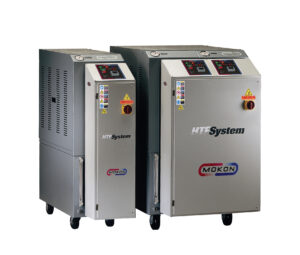
It’s easy to forget about your oil-based heat transfer fluid temperature control system when it’s properly working. To keep that peace of mind that comes when everything’s rolling, here are some ways to prevent damaging or ruining your oil system.
Some Brief Reminders
Oxidation and thermal degradation of system fluid are two things you should look for. In case you’re unaware, oxidation is the process of a substance combining with oxygen, and this reaction increases as temperatures rise. This results in oil-insoluble oxidized materials, raising viscosity and deposits.
Thermal degradation is the breaking of carbon-carbon bonds by heat to form smaller fragments (free radicals). If this degradation occurs at temperatures higher than 400°C (752°F), it will not only break carbon-carbon bonds but will separate hydrogen atoms from carbon and form coke (solid carbon deposits). This will cause the system to eventually cease operations, and since Mokon systems can reach up to 343°C (650°F), it’s something to watch out for. Repeated shut downs at elevated temperatures can also cause this.
Your Total Acid Number
Checking your total acid number (TAN) is paramount to maintaining oil system performance. A TAN is used to show the extent of a fluid’s oxidation. For perspective, new fluids have a TAN of less than 0.05; fluids should be changed once reaching 1.0 because it becomes a problem at that number. Serious issues arise when the TAN is 4.0 or 5.0; corrosion can occur, leading to leaks.
High acidity can break down oil, impacting its flow pass via the creation of sludge that clogs the path oil must travel through. The results can be hard and crunchy coke deposits (leading to equipment failure) or soft and tacky, indicating sludge (leading to reduced system efficiency).
Thermal Maintenance
Unlike checking your TAN, taking preventative measures against thermal degradation is easier. Regular maintenance on your oil system is key; running our DELFClean fluid to prevent the system from becoming fouled is a good start, as is regularly changing fluid when advised. Mokon oil systems avert conflicts with thermal degradation because of their cool oil reservoir; this separates the heating loop from the cooling loop and reduces oxidation rate or the breakdown of fluid. Cooling the system down below 79°C (175°F) prior to shutting it down is essential to extending the life of the system and the fluid.
Regularly changing your fluids is another way to incorporate thermal maintenance. Your oil should last approximately two years, at which point it’s time for a change. The type of heat transfer fluid (HTF) you use also plays a part. For example, Mokon’s DELF fluids use an additive mix of antioxidants, metal deactivators, a seal and gasket extender, and defoaming and particle suspension agents to help maintain system performance. DELF cleaners can help remove sludge and carbon buildup in tanks and process piping without disrupting production.
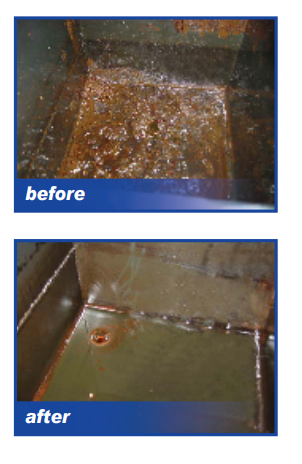
The above picture shows “before” and “after” a DELF cleaner is used.
How We Can Help You
To help keep your system running smoothly, Mokon offers a free analysis service to ensure your fluids have maximized efficiency. We also offer custom oil-based heat transfer fluid temperature control systems with single, dual, and triple zone configurations, flow rates of 5 to 120 GPM, and the ability to reach 343°C (650°F), among other features, so you can get exactly what you need.
If you have questions about your oil system, or are looking to buy a new one, contact us here or call us at 716-876-9951. We’re always happy to help.